Monday, November 15, 2021

A Legacy of Controversy: Carl Hagenbeck and the Modern Zoo

 Guest post by Maddi Brenner

The First of Many Zoos

The public zoo we know of today began as far back as the 18th century when Europeans believed in obtaining new avenues of knowledge and developing their role in science, reason and logic. The first zoo, then known as a zoological garden or park, was created in Paris, France in 1793 and continued its expansion to other nations in Europe.[1] Historically, zoos emerged from several individuals involved in the hunting, trading, capturing, exhibiting and breeding of animals.[2] A prominent example and figure that “older generations of Americans might remember” was Carl Hagenbeck.[3] According to Nigel Rothfels, Hagenbeck revolutionized zoo design, its commercial business and the fundamental practices of zoos.[4] 

A Pioneer of Zoo Curation and Practices

Born in 1844 in Hamburg, Germany, Carl Hagenbeck was a German merchant of wild animals and grew up alongside his father, Carl Hagenbeck Sr., as a fishmonger. As he grew older and increasingly interested in animals and the world, Hagenbeck began his travels to other countries, including but not limited to Egypt, Polynesia, Norway, Sweden and Finland. Around 1875, Hagenbeck traded his first “exotic” animals to zoos across Europe and the United States, where he combined his interest in commercial business and his love for showcasing to local folk. Carl Hagenbeck was so successful in his pursuit of animals and business that he used his skills to plan his own permanent zoo exhibit, then named the Park at Stellingen in Hamburg, Germany.[5] Daily, Hagenbeck journaled various methods and practices regarding the capturing and training of animals at the zoo. Highlights included animal trade, animal captivity and hunting, training wild animals and breeding. The first printing occurred in 1909, was named Beasts and Men: Being Carl Hagenbeck’s Experiences for Half a Century Among Wild Animals, with additional narratives and re-prints continuing until around 1912. Today, the book is still available and now translated into English and various other languages.[6]


source: https://collections.si.edu/search/results.htm?q=record_ID=siris_arc_399471&repo=DPLA 


Arguably, Hagenbeck was one of the most famous European leaders in zoo development. P. Chalmers Mitchell, secretary of the Zoological Society of London, reported Carl Hagenbeck as a prestigious figure with candor and stamina for animal trade and the zoo business. He described Hagenbeck as a “lover of animals and the greatest trainer” he’d ever seen.[7] His success and fame were so iconic that many animal traders and zoo directors across the world utilized his techniques. His popularity became known as the Hagenbeck Revolution, where his work resembled that “of a showman more than of a naturalist.”[8] In his memoir, Hagenbeck portrays his relationship with animals as one of curiosity and patience. He mentions his laborious training of sea lions and bears, along with his firm belief that animals held in captivity needed care and sanctuary. However, whether those feelings were for the actual good and nurturing of the animals, or due to his imperative need for breeding and animal trade to ensure business growth, is certainly up for debate.[9]

color sketch of a giraffe
Source: https://vintagraph.com/products/carl-hagenbecks-tierpark-stellingen?variant=12462662877286


The opening of the Park of Stellingen, today known as Tierpark Hagenbeck enabled Hagenbeck to explore various visual elements for animal exhibits. Most familiar and common today was a Panorama exhibit, which included barless habitats and revealed the animal in its more natural state using similar visuals of what one would see in the wild. These exhibits also gave zoos the opportunity to house many different animals in the same vicinity. With a moat that surrounded the landscape, animals could be viewed more easily (without bars). As Rothfels notes, these exhibits pointed to an illusion that allowed a visitor to idealize the world within the zoo itself.[10] Hagenbeck “wanted to create an animal paradise which would show animals from all lands and climatological zones in a manner suitable to their life conditions, not from behind bars and fences.”[11] His concepts and unique variety revolutionized the practice of zoo design and made him known as the inventor of the modern-day park. Tierpark Hagenbeck is still open today and has remained part of the Hagenbeck family business for more than 110 years. It is managed by the sixth generation of the Hagenbeck lineage and holds over 1,800 animals with 200 different species.[12]
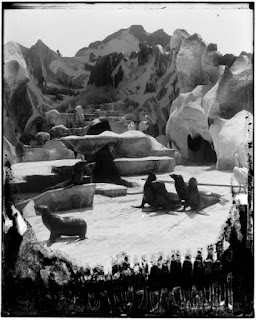
Seals in a barless exhibit
source: https://cdm17210.contentdm.oclc.org/digital/collection/lpe/id/3389 


Human Zoos and the Legacy of Hagenbeck

Hagenbeck considered himself an “ethnographic showman” who believed that humans, typically of African and Asian descent were also valuable for show. Hagenbeck presented people from various foreign countries to a European audience, including “Sami, Nubians, Inuits, Somalis, East Indians and other representatives of distant countries had to stage their everyday life and their cultures.”[13] In his memoir, Beasts and Men, Hagenbeck writes to his experience of ethnographic exhibitions as a lucrative enterprise that he believed would “indubitably cause a great sensation.”[14] Similarly, he corresponds, “I bethought me of the Eskimos, those dwellers in the Artic of whom we had all heard so much connection with polar expeditions, but who had never yet been seen in the heart of Europe. It might be possible, I thought, to bring a small party of these people to Hamburg.”[15]

Hagenbeck believed with a purpose that his role in showcasing humans was righteous and just. He imagined he had a responsibility to organize “frequent ethnographic exhibitions,” and wrote in his memoir, “one of the largest of all my ethnographic exhibitions was the great Cingalese exhibition of 1894. This great caravan, which consisted of sixty-seven persons with twenty-five elephants and a multitude of cattle of various breeds, caused a great sensation in Europe. I travelled about with this show all over Germany and Austria and made a very good thing out of it.”[16] With success of these shows across Europe, Hagenbeck believed these shows formulated and enriched “new forms of entertainment that fostered a revolution in the methods of training wild beasts for the zoo.”[17]

Those on display were working performers with tight schedules and little pay. Having been convinced to move from their home, these individuals and/or families often experienced traumatic, tiring and poor working conditions. For instance, “in 1880... an Inuit family on display died of smallpox because they had not been vaccinated. A group of Sioux Indians also died, of consumption, measles and pneumonia.”[18] Similarly, the parents of Theodor Wonja Michael traveled across Europe in exhibition as performers, after his father realized there weren’t many jobs being offered to a German of Cameroonian descent.[19] Michael recounts the experiences of his father, while speaking about his own experiences dancing and performing for an audience. He explains that the exhibits portrayed these cultures as “Africans: uneducated, bast-skirted and cultureless savages.” In a recent interview, 94-year-old Theodor Wonja Michael remembers being sniffed and gawked at while on display, including his speaking of broken German and/or sign language.[20] After Carl Hagenbeck died in 1913, his sons, Heinrich and Lorenz took over the zoo and circus business, continuing the human exhibits. Their last show of humans was in 1931, about 6 years after Theodor Wonja Michael was born into working these exhibitions.

Hagenbeck’s influence on modern zoo design was revolutionary. He remains one of the most famous leaders in zoo practices not only in Europe, but across the world. Yet, his legacy does live on in more ways than one. With recognition of his contribution to the success of zoos, awareness of his exploitation and ignorance at the expense of marginalized communities must also be. He used his privilege to perform incidents of power over people that cannot and should not be ignored. Today, there is strong criticism of zoo history and of Carl Hagenbeck, himself, who as a pioneer in zoo practices was also characterized as a deeply ignorant individual that supported the actions of bigotry. Much scholarship and recent contemporary articles shed light on Hagenbeck’s relationship with animals and humans. For better or for worse, we can use the historical narrative of Hagenbeck to acknowledge how we remember and understand the role of his work at zoos and in representation of various cultures today.

Epilogue: A Reflection on Hagenbeck and the Milwaukee County Zoo

At the Milwaukee County Zoo, habitat practices and modern zoo design were likely inspired by Carl Hagenbeck. During the 1920s and 30s, the Milwaukee County Zoo, then known as the Washington Park Zoo, replicated Hagenbeck-style exhibits with barless habitats, moats and natural views of the animals.[21] At the time, it was Director Edward Bean who fully embraced the performance of natural habitats in zoos and believed this type of display could enrich the experience of zoo-goers and animals. In similar ways, Bean and Hagenbeck both utilized showcase techniques that sought the enrichment of animals on display. Bean’s practices involved similar variations to Hagenbeck and ultimately transformed the ways in which the Milwaukee County Zoo is developed today.

Reference

Hagenbeck, Carl. Beasts and Men, Being Carl Hagenbeck's Experiences for Half a Century among Wild Animals. London: Longmans, Green, and Co., 1912.

Reucher, Gaby. “A Life against Racism: Theodor Wonja Michael.” DW.com. October 22, 2019: https://www.dw.com/en/a-life-against-racism-theodor-wonja-michael/a-50935425.  

Rothfels, Nigel. Savages and Beasts: The Birth of the Modern Zoo. Baltimore: Johns Hopkins University Press, 2002.

Theodor, Michael and Eve Rosenhaft. Black German: An Afro-German Life in the Twentieth Century. Liverpool: Liverpool University Press. 2017.

Zeitler, Anika and Rayna Breuer. “Carl Hagenbeck: The Inventor of the Modern Animal Park.” DW.com. November 6, 2019: https://www.dw.com/en/carl-hagenbeck-the-inventor-of-the-modern-animal-park/a-49106027.

“Zoological Garden.” Encyclopedia.com. May 21, 2018: https://www.encyclopedia.com/plants-and-animals/zoology-and-veterinary-medicine/zoology-general/zoological-garden.


[1] “Zoological garden,” Encyclopedia.com, May 21, 2018: https://www.encyclopedia.com/plants-and-animals/zoology-and-veterinary-medicine/zoology-general/zoological-garden.

[2] Nigel Rothfels, Savages and Beasts: The Birth of the Modern Zoo, Baltimore: Johns Hopkins University Press, 2002, 8.

[3] Rothfels, Savages and Beasts, 8.

[4] Rothfels, Savages and Beasts, 8-11.

[5] Carl Hagenbeck, Beasts and Men: Being Carl Hagenbeck's Experiences for Half a Century among Wild Animals, (London: Longmans, Green, and Co., 1912); see image of front entrance to Stellingen Park from Hagenbeck, Beasts and Men.

[6] Hagenbeck, Beasts and Men.

[7] Hagenbeck, Beasts and Men, x.

[8] Hagenbeck, Beasts and Men, viii-ix.

[9] Hagenbeck, Beasts and Men, 118-219.

[10] Rothfels, Savages and Beasts, 42-44.

[11] Rothfels, Savages and Beasts, 42-44.

[12] Tierpark Berlin, https://www.tierpark-berlin.de/en/.

[13] Annika Zeitler & Rayna Breuer. “Carl Hagenbeck: The Inventor of the Modern Animal Park.” DW.com. November 6, 2019: https://www.dw.com/en/carl-hagenbeck-the-inventor-of-the-modern-animal-park/a-49106027.

[14] Hagenbeck, Beasts and Men, 20.

[15] Hagenbeck, Beasts and Men, 20-24.

[16] Hagenbeck, Beasts and Men, 29.

[17] Hagenbeck, Beasts and Men, 30.

[18] Zeitler et al., “Carl Hagenbeck.”

[19] Theodor Wonja Michael was born in Germany in 1925 and considered a journalist and public servant. He was also a notable speaker on living as an Afro-German and a prisoner in Nazi forced labor camps during Nazi Germany. See Theodor Michael and Eve Rosenhaft, Black German: An Afro-German Life in the Twentieth Century (Liverpool: Liverpool University Press, 2017).

[20] Gaby Reucher, “A Life against Racism: Theodor Wonja Michael,” DW.com, October 22, 2019: https://www.dw.com/en/a-life-against-racism-theodor-wonja-michael/a-50935425.

[21] See Milwaukee County Zoo postcards that show images of barless habitats circa 1920s and 30s through the UWM Archives Digital Collection here.

Friday, December 11, 2020

Hungry for the Archives

Guest Post by Avery Schulze

One of the greatest experiences for this this semester was the chance to work directly with finding and using primary sources for historical research, an obvious cornerstone to the course. Going back to the previous semester, I was in the middle of developing my central research questions for my capstone research paper for my Urban Studies undergrad on spatial mismatch and public transportation access in the Milwaukee Metro. I wanted to gain access to the library on campus to access primary source documents because I wanted my methodology of research to include some historical research. But Covid-19 came along which prevented me from being able to participate in accessing these primary sources, which really was a blow and letdown, as in many cases I needed to see physical copies.

This class, while online and of course despite still not being able to access primary source physically, has given me a taste of what it is like to work with primary source research. I really appreciated the outlined bibliography of characters for our Twitter reenactment provided by Mark Langenfeld. I searched the UWM online archives and found it difficult to find information on Cleveland Abbe, perhaps because I was inexperienced in my methods of searching or perhaps because Cleveland Abbe, while relevant to our course, may not have been relevant to Milwaukee outside of his collaborations with Lapham. It's possible that I would have found him mentioned in primary sources by Increase Lapham, but I needed primary sources by Cleveland Abbe, which were not abundant in the UWM Archives, or, like I said earlier, maybe I was inexperienced in searching. Overall it would have been great to have had the hands-on experience of sitting in the archive section of the library to find sources; that's something I feel I would love to pursue in future research if the opportunity presents itself. Overall, I had some knowledge on primary sources and how to interpret them but I've learned quite a lot in this class on building that skill. I can say that it has really been a joy being able to get a taste of primary source research in this course. 

The UWM Post

Guest post by Agnes Lopez Flores

My research for this class was done through the UWM library system. Archivists like Abigail Nye set up fantastic resources to teach students how to use the online search engine on the library website. I mainly focused on the Archives and Special Collections for these projects. While it is best to be able to see and interact with the physical documents, I preferred finding a resource that was uploaded digitally in case the library became unavailable due to Covid-19. I believe archives are still working on digitizing many of the items of their collection so I am sure I missed many great primary sources. 

What is good about digital collections is that I get a wider view of the variety of resources in archives. This is the copy of the UWM Post I used for my primary source analysis.

A page from the UWM Post

While doing research last year in the same realm, I did not even think about the UWM Post as a source; so this helped me think of other topics I could research.

Thursday, December 10, 2020

Searching for Byron Kilbourn

Guest post by Jonathan Santiago

My experience of searching for primary sources was difficult in the beginning, but that is mainly because of what I had in mind for my primary source. This class provided me with very helpful resources and advice that I used to look for primary sources; however, I wanted a primary source from a specific character that I had learned about in class and from the readings. Therefore, this made my experience a little more difficult than it needed to be since I had to do a bit more digging to find the info that I wanted. At first, I had used the library to search for primary sources, but after a while of searching and not finding the information that I wanted I soon went to Google. I ended up finding a secondary source that contained primary sources. This article talked about Byron Kilbourn, which is the person who I wanted to find info on, and gave lots of background info on him and his impact on Milwaukee, but what most intrigued me was the primary source that the article contained which was an advertisement flyer. This flyer dated back to 1851 and was the perfect form of a primary source that I needed since it had a direct connection to the information on Byron Kilbourn as well as his overall impact on this city and its railroads.

Tuesday, December 8, 2020

Wisconsin’s Voting Rights: The Path to Equality

Guest Post by Clayborn Benson III

African Americans have played a part in Wisconsin’s history since the very beginning of the state’s history, working as trappers, guides, and frontiersmen. They roamed the territory with Pere Marquette; they had strange names like Black Bart, James Pierson Beckwourth, Claude and Mary Ann Gagnier, Toby Dodge, and the Bonga Family (Pierre, Joas, Marie Jeanne, and George).[1] They roamed from Green Bay to Prairie du Chien. They harvested the lumber from Superior, WI and traded with the native Indians in Peshtigo County. The numbers of African American citizens were never significant enough to outpopulate anyone; however, they influenced almost every political decision made in the state. African Americans were encouraged and invited to relocate to places like Freedom, WI, (north of Appleton) named in honor of an African American, James Andrew Jackson, WI. They settled in all kinds of places you would never imagine, and they were a big support to the European citizens. They spoke many European languages and even influenced the architectural design of the round barns, although their population was still less than one percent.

In 1846, when Wisconsin made the decision to become a state, the founders included in the constitution that African American men should have the right to vote, as any other citizen. Not only were there fierce debates in the state legislature over African American suffrage in 1846, they were even referenced as the “N” word in the state legislature, when their numbers in no way represented a serious threat to the percentage of the state’s population.[2] “Free and unequal” is a descriptive term to describe my view of how African Americans have been treated, particularly in Wisconsin. There are three major things that African Americans have had to fight for throughout our presence in Wisconsin, 1) education 2) fair and decent housing, and 3) the right to vote. For the purposes of this paper, I will focus on suffrage or the right to vote.

According to Michael J. McManus, PhD, “Disfranchisement implied that blacks not only were undesirable members of their communities but were incapable of exercising the rights and responsibilities of citizenship. In addition, the attitudes that deprived blacks of the right to vote in the North mirrored those same principles that in the South reduced them to servitude.”[3]

We don’t have to go back very far to see the current and blatant voter suppression tactics used in Wisconsin. In April 2020, during the mayoral election in Milwaukee, only five voting places were made available for the 31st largest city in the United States.[4] On a cold, damp spring day, during the coronavirus pandemic, people stood in line for hours waiting for the opportunity to exercise their right to vote. In addition, African American men and women who have violated state laws, resulting in jail time, also lose their right to vote. This is just one more way that African Americans are disenfranchised.


In 1846 the founding fathers put in Wisconsin’s constitution that all men should have the right to vote. White citizens in the western part of the state, where slavery existed, voted against African American men having the right to vote.


Statehood election took place in 1848, but African Americans were not permitted to vote. The state’s founders realized that giving the right to vote to African Americans was something they wanted to do, so they called for the first of two referendums asking for African Americans to have the right to vote—one in 1849 and another in 1857.


In 1854, Joshua Glover[5], a fugitive slave from St. Louis, was arrested and broken out of jail at Cathedral Square in Milwaukee. This was in direct conflict with the Fugitive Slave Law passed by U.S. Congress just four years earlier. Wisconsin was one of the only states in the Union to openly defy the Fugitive Slave Law. The thing that makes this unique and special is that the governor and abolitionists all believed that defying federal law was the right thing to do. Wisconsin’s Governor Alexander Williams Randall asked that the local militia stand ready to protect the state; because of their actions President Buchanan was threatening the state for violating the Constitution.[6] How did the more than 99.9 percent white citizens justify taking an abolitionist’s position of breaking a slave out of jail yet continue to disenfranchise African Americans by refusing to allow them the right to vote?


There are conflicts between the Irish community, lynchings, and conferences on the issue of voting rights. The 1850s brought a great deal of attention to the question of whether African Americans should have the right to vote. In 1857, the state decided to bring the issue before the public again as a referendum item in a gubernatorial election of William Randall. They won the right to vote but it was contested by citizens in the Western part of the state in 
court because they saw the right to vote as a path to citizenship, which they opposed. After the Civil War, African Americans began asking when they would get the rights they were entitled to. The issue of voting was not just about giving African Americans the right to vote, but rather empowering them to become equal citizens. After Ezekiel Gillespie, a well-known Milwaukee entrepreneur had a dispute in a barbershop regarding African Americans’ right to vote, he enlisted the help of Sherman Booth and Attorney Byron Paine to petition the court on the matter. The court reviewed the issue and found that it was no more than a mathematical error; the totaling of the votes showed that they had the right to vote dating back to the first referendum ballot in 1849. For more than 100 years no one took the liberty to explain why there were miscalculations of the vote dating back to 1849.

In 2020, Wisconsin, along with the nation is celebrating the 100th anniversary of women’s suffrage.[7] It’s clear that the right to vote brings about citizenship, equality and empowerment, while at the same time African Americans continue to be disenfranchised through voter suppression, photo ID requirements, closing polls in the African American community to control election outcomes and refusing to reinstate voting rights to individuals previously incarcerated.


[1] Barbara J. Shade, “Afro-Americans in Early Wisconsin,” Transactions of the Wisconsin Academy of Science, Arts and Letters 69 (1971): 113-116.

[2] Michael J. McManus, Political Abolitionism in Wisconsin, 1840-1861 (Kent, OH: Kent State University Press, 1998), 19-21.

[3] McManus, Political Abolitionism in Wisconsin, 21-23.

[4] Brennan Center for Justice, June 24, 2020 and David Haynes, Want to Make Voting Easier in Wisconsin? Here Are Nine Ways to Do It,” JSOnline, https://www.jsonline.com/story/news/solutions/2019/12/20/want-make-voting-easier-wisconsin-here-nine-ways-do-it/2700442001/ April 9, 2020.

[5] C. C. Olin, The John Olin Family History, 1678 to 1893 (Indianapolis: Baker-Randolph Co., 1893).

[6] James Doolittle Papers; Message of Governor Alexander Randall to the Citizens of Wisconsin, in the Milwaukee Sentinel, January 16, 1858.

[7] Remarks by Dr. Turkiya Lowe, Chief Historian and Deputy Federal Preservation Officer, National Park Service, Wisconsin Historical Society Virtual Annual Conference 2020, https://wisconsinhistory.zoom.us/rec/play/HyXHrMNT84s9ol2KBvlnNHSLE5CC8M4FEC50iB3q9UveQLu7u_zNBQRjjfx9CWKJUvA-ApBLi7PvKgpK.a_u_1PIeai2Sfv5H.

Thursday, December 3, 2020

Conducting Primary Source Research in a Pandemic

Guest Post by Lillian Pachner

Conducting primary source research for this class proved to be a pretty big challenge for me. I have never really done primary source research at this level before so I had to learn a new skill. On top of that, this is a skill I will have to re-learn in the future, because I had to learn to navigate doing primary source curation and research completely virtually. Eventually I will have the learning experience of going to the archives in person, post pandemic. I began conducting my research by virtually meeting with Abigail Nye. She walked me through how to find relevant digitized archives and other aspects of doing academic research. She was extremely helpful. This whole experience was entirely out of my comfort zone. Talking to new people, especially virtually is a huge challenge for me (social anxiety), so that was definitely something I had to overcome to get through this experience. All in all though, I feel really good about what I did under these circumstances. I am leaving this semester feeling so much more prepared and equipped as a history student. I can’t wait until this pandemic is over so I can really dive deep into archival research.